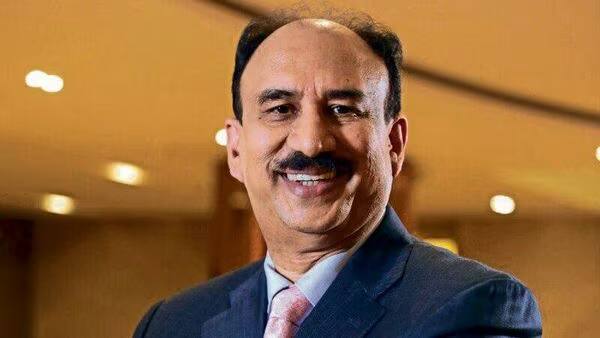
A proud alumnus of TISS, Dr. Santrupt Misra is CEO, Carbon Black Business and Director, Group Human Resources of the Aditya Birla Group. He is a Director on the Aditya Birla Management Corporation Private Limited Board, the apex decision making body of the US $40 billion Aditya Birla Group. We met him at his office and discussed his reflections on the interface of industry and institute, business and HR, and his life at TISS.
Editorial Committee (EC)– Sir, there has been a much debate about Ram Charan’s article- ‘It’s Time to Split HR’ in HBR. Dave Ulrich even published a rejoinder to it in HBR itself. What is your take on the idea espoused in this war of words?
Dr. Santrupt Misra(DSM): I don’t necessarily agree with the Ram Charan’s article. There are examples of people who did not come from human resources background and failed in the HR function. I have read the recent article in the December issue of HBR, where Dave Ulrich talks about why HR people will make better CEOs and how researches show that they have qualities close to what CEOs are supposed to have. Look, in thought leadership, people will always talk about concepts and ideas unless, there is empirical evidence to know about which concepts and ideas are right or wrong. The important question to ask for people such as you or me, who are part of HR profession in the world and in India is – Are businesses receiving enough contribution from us? Are CEOs and line managers happy with what we are doing? And if they are not, what’s the problem and how can we up our game in a manner that we deliver superior value to key stakeholders i.e. employees, line managers, board of directors etc. I think the dissatisfaction comes because we are not, perhaps, investing ourselves enough into knowing the business processes and the value drivers, understanding the pressure points of business, and tailoring our solutions and responses to the needs of business. Perhaps there is a perception that we are too clichéd. We are applying the same medicine irrespective of the disease. We need to design more targeted human resource strategies. We need to ask more searching questions. For example, what indicators should tell us that whether our quality of talent in a business is high or not? We need to ask more fundamental questions. Often in HR, we have to ask tough and more fundamental questions at a deeper level but in a subtle and softer way. The controversy is around how do we build effectiveness and competencies of HR people and how do we make our contribution to the organization tangible and palpable. We should remain conscious about that dimensions of our performance. Dialogues and debates should go on but more important question for us is to ask that how do we keep ourselves relevant to the business.
EC: Most business graduates are equipped with only a theoretical perspective on the organizational issues but the realities that these organizations offer to them need not necessarily be the same. How can institutes and organizations contribute towards bridging this gap?
DSM: In Tata institute of social sciences, you are lucky to have field work (smiles). This is a unique opportunity. You need to understand the real significant prospects of what field work can do. First, if you can take even 30-40% advantage of the exposures given to you, it will be greatly beneficial. Second, your interaction with the visiting faculty members and asking them questions from a more practical point of view is very useful. Knowledge by nature can be conceptual and any concept or theory is nothing but a refined practice. Over a period, people have formulated practices into some kind of theory. Let’s take an example of an organization based in a rural location and currently employing 1000 people, but all males. In next three years time, this organization wants to reach a situation where at least 10% of workforce is women. How will you go about promoting this as an attractive workplace for women to work? Now, to solve this problem you require application of a mind which understands diversity as a concept. A problem, most often, is not completely practical or theoretical in nature. This problem combines a theoretical question with a practical understanding of diversity. You need to ask fundamental questions-What is your concept of diversity (a theoretical question)? Which forms of diversity will be more difficult to build in a rural location and how would you overcome it (a practical question)? There is a range of things which students can do, the faculty can do and they both can jointly do to make students more practically oriented. You must understand that the purpose of learning is to contribute and to make yourself more effective than before. Rather than mindlessly studying only to memorize, ask yourself where and how am I going to apply this? Which part of it will work and which part will not? Asking questions like these will make eventually you more practically oriented.
EC: Speaking further of the Industry-Institute interface, the HR curriculum is tailored to the needs of the entire career span. This enables students to learn about transformative and strategic role of HR, which they may only be assigned at levels of Senior Management. Do you think that the current generation lacks patience in the initial years when they should understand the concepts & practices first and then think about building the strategy?
DSM: Lack of patience is not a bad thing per se, as far as you know how to handle it. We are who we are. Having a weakness is not a big problem. The real problem lies in, not being able to recognize the weakness, not realizing how it is impacting you, and not being able to handle it appropriately. Successful people know how to leverage their strengths and how to deal with their weaknesses. So think it this way that “Ok, I will be lucky if I get a meaty job”. By and large, 90% of people do not get something meaty in the initial phase of their career. Another way of looking at it would be that “Whatever assignment I get, I will make a huge success out of it”. Look, someone may get an excellent job but make a mess of it or someone may get an ordinary job and get an outstanding success out of it. Essentially, every job is great and offer ample opportunities. What you want out of it is your choice. The problem with educational institutions lies in too much of peer-pressure and unnecessary, irrelevant and unfocused conversations among students. Frustration builds up when people fail to leverage these opportunities. There is a philosophy which says, “If you can’t marry the girl you love, you love the girl you marry”.
EC: Being a CEO, how differently you look at the HR field now than the time when you were the CHRO?
DSM: Being a CEO does not necessarily mean a bigger thing than being an HR professional. You can have CEOs who are irrelevant while you can have HR professionals which are very relevant. We tend to create all kind of hierarchies of fields within the HR profession. I don’t believe in that. Do what you enjoy doing, be it IR, OD or any other field. Do something because you believe in it, not because people are doing it. Anything you do, do it to the best of your capabilities so that the opportunity is not wasted. When you do different roles, demand of the roles will be different. For instance, when I visit a plant, I will meet a chairman who is my customer, I will also meet a chairman who is a joint venture partner with me. So, in one trip I am going to play three different roles. To be a CEO, you must learn to enjoy doing that. Before these meetings, I must research on all aspects of these three meetings- what I want to accomplish, what I need to discuss and what changes took place between two consecutive meetings with the person. In any field of work, homework and preparation makes you successful, be it an HR role or a CEO role. Only the skills required and demands from the roles change. There will be some extra casualties involved such as a higher level of stress, lower privacy and personal space, working with changed time horizons such as USA or China time zones. When there are 17 plants in 14 countries, there are high probabilities that one thing or the other will be going wrong somewhere at a time. These two different roles entail different kind of challenges; require different mindsets and skills and you should be deft enough to switch between the two.
EC: In ABG, there are multiple plants cutting across multiple geographies and businesses. How do you manage diverse aspirations of such a large number of workers?
DSM: First of all, you should have a broad framework. There can be various types of frameworks. One framework could be being fair and firm to workmen. Another could be providing welfare, safety and care. One more framework could be providing opportunities, learning, growth and support to their families. Within the chosen framework, you offer a range of things. You do not try to find convergence of everyone’s interests. This is not possible. For example, requirements of women employees working in rural areas will be very different from urban factory workers in Mumbai. A first generation workman from a remote green field site will be different from a workman who has been in a mature factory for 25 years. Within this broad framework of your approach towards workmen, you operate flexibly to meet their needs in different location. Operate flexibly, keep your ears to the ground, know the pressure points and try to be as fair and firm as possible.
EC: Please share with us a few things that TISS contributed to you.
DSM: There are many things TISS contributed to me. The biggest one is that it exposed me to the organized industry, with which I never had an experience. I had never seen factories from so close. The image of a disciplined factory working is something that TISS contributed to me. Secondly, TISS reinforced my belief that all that glitters is not gold. Thirdly, I learnt that people can’t hide behind English for too long; content wins. It taught me that I can succeed if I tell myself to do a few things differently. There are many memorable experiences. I remember once I was asked to do a project on dearness allowance. I studied 160 court cases for that one project in a period of one month. For another presentation in my first year, I read 5-6 books. The professor said that this was the most brilliant presentation he had seen on that subject. TISS taught me that people appreciate quality.