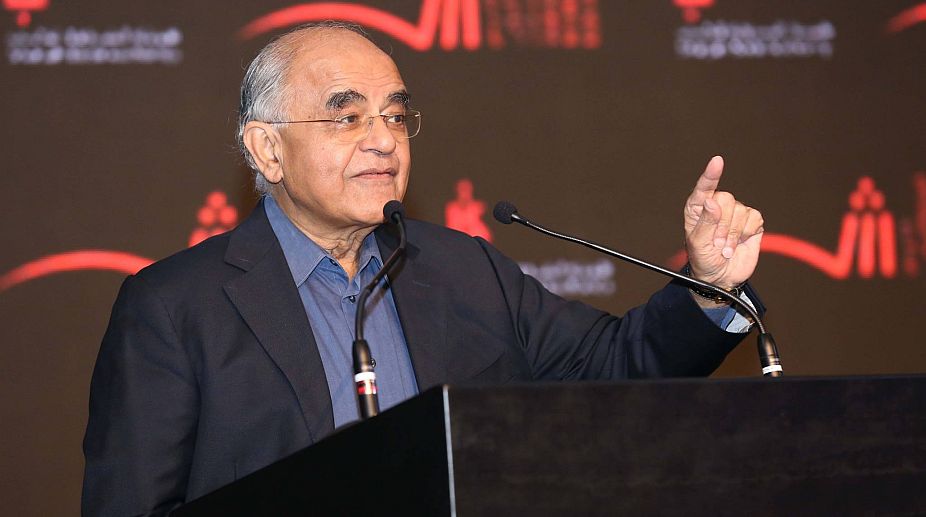
IS A HARVARD UNIVERSITY GRADUATE IN PHILOSOPHY, IS A PUBLIC INTELLECTUAL AND THE AUTHOR OF TWO INTERNATIONAL BESTSELLERS, ‘INDIA UNBOUND’ AND ‘THE DIFFICULTY OF BEING GOOD’; HE HAS BEEN A REGULAR COLUMNIST FOR MANY INDIAN PAPERS AND HAS WRITTEN PERIODIC PIECES FOR THE NEW YORK TIMES, WALL STREET JOURNAL, FINANCIAL TIMES, AND MANY MORE. HE HAS ALSO BEEN THE CEO OF PROCTER & GAMBLE INDIA AND MANAGING DIRECTOR, STRATEGIC PLANNING OF PROCTER & GAMBLE WORLDWIDE
In your book, India Grows at Night’, you say that India has risen despite the state rather than due to government policies. With the same perspective, we would like to talk to you about the prospect of labor reforms. In the 1970s and 1980s, India experienced major labor unrest. With the advent of liberalization, the situation did improve but worsened again by around 2008-09. How will labor reforms help improve the situation?
One of the reasons India has failed to become a manufacturing nation is our rigid labor laws which make us uncompetitive as a nation. This failure has meant that labor has also lost out. East Asia, Southeast Asia and now China have become successful manufacturing nations partly because of labor flexibility. We must protect workers, not jobs. Hence, the reform of labor laws is crucial. For fifty years a small labor aristocracy has held to ransom the interests of the vast majority of India’s workers. Today, industrial labor is hired mostly on a contract, which deprives workers of long term benefits. So it will be in the interest of labor that reforms are enacted. The fundamental reform we need is the flexibility to lay off workers when demand slackens. But a ‘hire-fire’ policy also requires a safety net.
Today, there is little prospect of real labor reform at the Centre because of gridlock in parliament. Modi has told the states to do these reforms. So far. four states have done significant labor reforms-Rajasthan, Gujarat, MP, and Andhra-and the rivalry between states for investment will ensure that the others will follow suit.
What are your views on corruption in the new age industries like IT, even though they are largely unfettered by bureaucracy-for instance, the Ramalinga Raju case?
Well, frankly, in IT industries, there is little red tape compared to manufacturing. What may stop their progress is, land acquisition. And in land acquisition, there is definitely corruption. This again depends on the state you are talking about. Some states have been very innovative like Andhra Pradesh which has a ‘land pooling scheme’ for acquiring land where farmers benefit by becoming shareholders in the land. About Ramalinga Raju, in every society, there are crooks. So. I wouldn’t worry too much. It’s a normal distribution. You will have some geniuses, some good people and some crooks. And this is why we need the police and the judiciary. We need to speed judicial processes. Even in the Ramalinga Raju case, it has taken too long for the law to take its course. Yet, in this case, the government did do a good job. They appointed a committee which eventually managed to find a buyer for Satyam in Tech Mahindra.
In the past decade, we have seen the rise of many start ups. Many TISSians as well, dream of starting something of their own. But, not all of them can become a Flipkart or alike. Do you think this is a bubble which is going to burst someday or will it sustain?
All bubbles eventually subside. Four out of five enterprises fail. But still entrepreneurial bubbles are a good thing because they give young minds the motivation to innovate, take risks, and take charge of their lives. As they say, ‘Its better to have loved and lost than never to have loved at all.’ It’s better to have tried to become an entrepreneur than not. It also gives people an opportunity to follow their passion and that is what life is all about.
This actually brings us to the main function of HR in a company. HR should give people an opportunity, to recognize their true potential, their actual passion and the sources of their real happiness. People spend a major chunk of time in their lives working and if they are not happy working, then there is no point in it. When asked ‘what is the secret of happinesss?’ Dr. Sigmund Freud, answered: to love the work you do and to love the person you live with. Life is not only about climbing up ladders, buying a fancy home and a car. It is about fulfilling a passion and being happy.
What do you think are the mechanisms that HR can use to ensure such happiness and to retain their employees? In today’s world, globalization has made better opportunities financially available abroad. In your opinion, what can Indian companies do to retain the brains of India within Indian companies?
I think a major source of unhappiness in an organization is the behavior of the boss. Many bosses do not know how to behave and so, employees get turned off. This is something that should be worked upon through adequate training programs. Secondly, managers in early stages of their career, should ask themselves whether they find their work rewarding in terms of feeding their passion. So companies should give employees the chance to think through this and find their place in the company. One way of finding whether or not your work makes you feel happy is time distortion. Sometimes time passes away so quickly that you think its 4 o’clock but it is actually 6. This indicates your real involvement in the work you have undertaken. Another, is the kind of work in which the clock ticks slower than usual. Well here, certainly, you must re think on what kind of work you want to engage in.
The great mistake that companies and HR make is to hire for skills and not for attitude. We should hire for attitude and train people in skills. Attitudes cannot be changed after the age of 3-4 years while skills can always be learned. Some of the great leaders who I have met were not the most intelligent, but had the right attitudes-they had qualities of determination and curiosity.
In an HRM Summit organized by the Confederation of Indian Industries, you mentioned two very significant points. First, for leaders, good execution is more important than good strategizing. Second, good leaders are built through campus hiring, not through mid level hiring. Could you please elaborate?
Definitely. Anyone can get a good idea but only a few can execute it well. Of course, you need both skills but given a chance to choose between the two, I would choose a person better at execution than strategizing. And indeed, I believe strongly in campus hiring. I have learnt that if you hire people at a young age, provide them with an environment to grow, you will have them for a long time. Campus hiring increases the scope to fill vacancies through promotions from within and raises motivation. When you hire at the campus, remember this: HIRE FOR ATTITUDE AND TRAIN PEOPLE IN SKILLS.
Any message for the young minds of our generation.
If you want to be happy, find your passion. It is a simple idea, but it’s timeless.