In late 2025, I caught up with two of my favourite business leaders, Rahul and Kiran, over one of our quarterly lunch sessions. I have known both for years. They are the kind of leaders others gravitate toward: vibrant, deeply invested in their work and their people, ambitious yet grounded, full of curiosity and life.
That afternoon felt different.
The conversation was familiar – markets, talent shortages, AI investments, delivery pressure. Yet there was an undercurrent that kept surfacing in small, almost unspoken ways. Longer pauses. Half smiles. A sense of being slightly out of breath, even while sitting still.
At one point, Kiran stirred his coffee absent-mindedly and said, “I’m busier than I’ve ever been. But I don’t always feel useful in the way I used to.”
Rahul nodded. “We’ve become very good at moving fast,” he added. “I’m not sure we’ve become equally good at noticing how it feels to keep up.”
They weren’t exhausted or resisting change. They weren’t burnt out. They were performing. They were
succeeding. But something essential felt diminished. They were articulating something subtler, the emotional cost of constant adaptation.
That lunch has stayed with me because it captures a paradox I now see everywhere: as organizations become more agile, work is quietly becoming less human.
The Agile Paradox
Agile HR emerged to solve a necessary problem. Traditional people systems, built for stability and scale, could not keep pace with volatility, digitization, and compressed decision cycles. In response, organizations embraced faster planning cycles, decentralized decisions, and continuous feedback.
These changes delivered real gains.
And yet, by 2025, Gallup’s organizational data paints a clear challenge: only 21% of employees globally
report being engaged in their work, while 40% experienced significant stress on a daily basis. A gap that
urgency alone does not fix. The limits of a purely operational view of agility are becoming visible.
The issue is not agility itself.
It is agility without sustained human anchoring.
To endure, Agile HR must evolve from enabling speed to designing coherence. One way to anchor this is
through the F.E.E.L. lens.
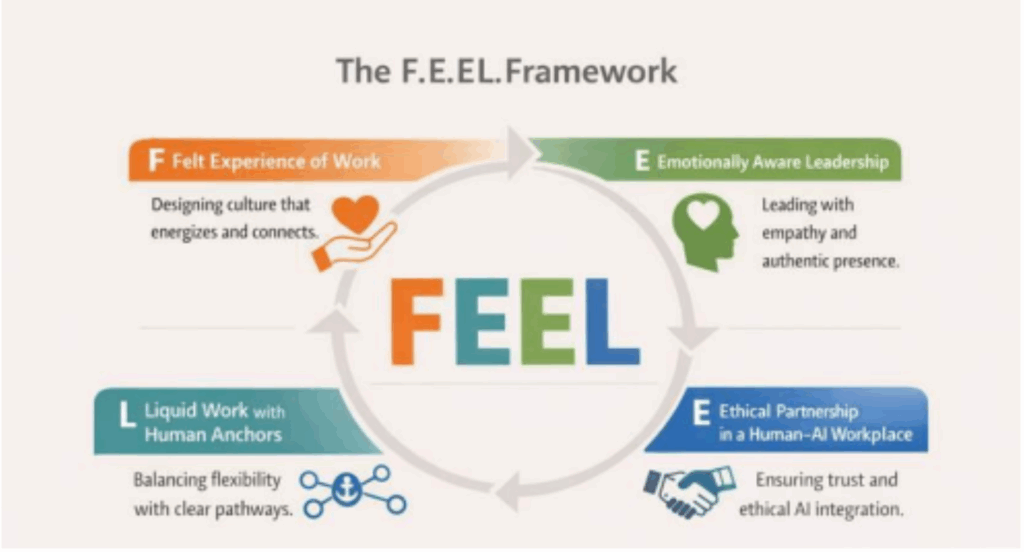
The F.E.E.L. Framework
F — The Felt Experience of Work
Culture today is experienced less through formal statements and more through lived moments: how priorities shift, how meetings begin, how decisions land.
This disconnection is rarely dramatic. It shows up in how workdays feel, fragmented rather than full, efficient rather than energizing. Culture today is shaped less by what is declared and more by how these moments accumulate.
These are not statistics; they are the emotional backdrop of everyday work. The felt experience of work,
psychological safety, emotional energy, cognitive load, autonomy, belonging, is shaped by everyday design choices. How feedback is given. How availability is interpreted. How mistakes are handled. These small moments accumulate into culture.
Agile HR reframes culture as something to be intentionally designed, not symbolically stated. The People
function increasingly acts as an experience designer. Creating defaults and rituals that help people do their best work without constant emotional tax.
E — Emotionally Aware Leadership
Leaders increasingly recognize this reality. According to SHRM’s 2026 priorities research, 29% of CHROs now place employee experience at the top of their agenda, and 31% emphasize workplace culture, up
significantly from just a year before.
One executive shared with me recently that his team did not resist a new operating model, but they missed moments where leadership paused to explain not just the what, but the why behind it.
Emotionally aware leadership is not about slowing decisions. It is about recognizing that change is absorbed emotionally before it is executed operationally. Employees adapt faster when leaders create space for sense-making – when they listen, acknowledge uncertainty, and explain the why, not just the what.
Agile HR must treat emotional awareness as a core leadership capability, embedding it into coaching, feedback, and performance expectations. Not as an optional soft skill. In continuous change, presence often matters more than precision.
E — Ethical Partnership in a Human–AI Workplace
During a pilot of AI-assisted decision tools, a young analyst told me, half-jokingly, “My new colleague never sleeps, never doubts itself, and always sounds confident.” Then she added, more seriously, “I’m still figuring out where that leaves me.”
By mid-2025, Gallup studies that the share of employees who believe their organization has implemented AI rose to 44%, up from 33% the year before, showing how rapidly these tools are spreading.
This adoption opens opportunity and uncertainty. As AI moves from automation to agency, work is increasingly co-created by humans and machines. The challenge is no longer technical feasibility, but human meaning, especially when work has long been a source of competence, identity, and pride. When machines outperform visibly, anxiety follows, not just about jobs, but about relevance.
Agile HR must therefore focus on ethical integration: clarifying accountability, protecting judgment, and
reaffirming what remains distinctly human: ethics, creativity, relational intelligence. Rehumanizing work means ensuring technology amplifies dignity rather than eroding it.
L — Liquid Work with Human Anchors
Work is becoming fluid. Skills matter more than roles. Careers look like portfolios, not ladders. This liquidity creates opportunity, but it also creates uncertainty.
Access to opportunity matters. According to LinkedIn’s 2025 Workplace Learning Report, employees with
access to internal mobility opportunities are significantly more likely to stay with their organizations,
pointing to how liquid models that provide clear paths can anchor people even as work structures flow.
A few months ago, an employee described her career progression as “a series of exciting projects held together by a vague sense of belonging.” She loved the flexibility. She just wished she knew where she truly stood.
The role of Agile HR is to enable movement without disorientation. To balance flexibility with anchoring.
Transparent access to opportunities, clear contribution-based rewards, and stable purpose provide the
psychological safety people need to navigate constant change.
The most humane agile organizations are not those in perpetual motion, but those that combine adaptability with reassurance.
Trust: The Quiet Enabler
Across all four dimensions, one condition determines whether Agile HR succeeds or fails: trust.
Agility depends on distributed decision-making, rapid feedback, and tolerance for experimentation. Without trust, these quickly collapse into control, fear, and exhaustion.
The work of Agile HR is to create conditions where people feel safe to engage, adapt, and grow, not just to respond or react. Trust is built through consistency, between values and behavior, promise and experience, performance, and reward. In uncertain times, people may not expect certainty, but they do expect honesty and coherence.
Coming back to Lunch
I often think back to that lunch with Rahul and Kiran.
As we stood up to leave, Rahul smiled and said, “Same time next quarter?” Kiran laughed. “Hopefully with fewer dashboards and better stories.”
That, in many ways, captures the future of Agile HR.
Not fewer ambitions. Not less speed.
Just more attention to how work feels while we move forward.
Because when work feels human, people don’t just keep up.
They show up: fully, thoughtfully, and with energy to spare.
And in a world that will only move faster,
that may be the most sustainable advantage of all.
About the Author

Kavita is the Senior Vice President and Chief People Officer (CPO) at Cyient. With over 25 years of experience, she brings global expertise across industries including FMCG, Media, Not-for-Profit, BFSI, Technology, and entrepreneurship. Kavita is a skilled leader in driving organizational agility, shaping talent strategies, and leading complex transformations such as M&As. Her expertise spans General Management, Finance, Sales, Customer Experience, and People Practices, with a focus on leveraging human capital to fuel business success.
At Cyient, Kavita is responsible for strengthening our people, talent strategies and driving initiatives that enhance associate experience.
Outside of work, Kavita is a passionate traveler with an interest in cinema, books, and music, and she is deeply curious about culture, leadership, and storytelling.
Follow and connect with her on LinkedIn | Write to her at [email protected]